
Vasco Melani’s whole life was distinguished by fervent cultural activity. From an ancient Tuscan family, the artist was born in Florence in 1910. After training at the Porta Romana Art Institute, he moved with his family to Milan at the beginning of the 1920s where, at the age of seventeen, he enrolled at the Brera Academy of Fine Arts. He soon became a member of the group made up of Munari, Fillia, Prampolini, Andreoni, and Marasco. In June 1929, he was participated in the 55th Mostra Sociale della Famiglia Artistica at the Galleria Micheli where he signed his works “Vasquez M.”. In October of that same year, Melani exhibited nine works in the exhibition of Futurist architect Sant'Elia and twenty-two Futurist painters that opened at the Galleria Pesaro in Milan. Returning to Florence in 1932, he resumed his association with Antonio Marasco and took part with him in the Gruppi Futuristi d’Iniziativa and the Futurist Art Exhibition at the Palazzo Ferrni gallery in Via Tornabuoni. He took over management of the newspaper "Larno" and was responsible for news and art criticism in the local newspapers. In addition, his signature and illustrations appeared very soon in "Frontespizio", Florence’s main cultural magazine of the period, managed by Piero Bargellini and edited by Vallecchi. In 1936, Melani left for East Africa as a volunteer officer. Two years later, he wrote a journal in which his initial enthusiasm for that campaign gave way to a fierce criticism of the horrors and cruelties of war. Full professor of drawing and history of art, painter, and writer, Melani participated in the most noteworthy avant-garde movements, from Futurism to Neo-realism, participating in exhibitions in Italy and abroad. His works are found in churches as well as in public and private collections. For over twenty years, Melani was director of Pistoia’s Civic Museum and Honorary Inspector of the Superintendencies. In 1944, he managed "La Voce del Popolo", the organ of Pistoia’s C.L.N., and was editor-in-chief of "Non Mollare" of the Partito d'Azione and the "Vita dei Campi". He worked on such newspapers as "Giustizia e Libertà", "La Patria", "Il Nuovo Corriere", "Il Giornale del Mattino" as well as on Encyclopaedia Britannica’s 1960 edition. Melani was among those who supported reopening Pistoia’s Art Institute, taking on the role of director between 1946 and 1950. In 1946, he founded and directed the Saletta Masaccio, a contemporary art center and promoted a national campaign to protect his city's artworks. In 1947, he participated in the Pistoiese July exhibition and competed, the following year, for the Antonio Gramsci Painting Award. Melani also directed archaeological essays on the area, creating a new cultural interest in Pistoia and founding the first archaeological group active in the Pistoia countryside. He wrote numerous publications for the Civic Museum, where he became director in 1956, and for Italian secondary schools. Alongside the museum's functions, Melani created a new exhibition space for Ghibelline Hall, located first in the town hall from 1956 to 1958 and later in Palazzo Marchetti until 1971. In December 1956, the Ghibelline hosted the first numerically complete exhibition of Fiamma Vigo’a publication, “Numero”. The following year, the sixth exhibition dedicated to Austrian artists who were members of the Kunstlerhaus was inaugurated. For more than twenty years, he organized in the Ghibelline Hall a series of events called "Modern Art Weeks" that introduced the public to the most significant international art events, created a cultural center capable of offering sound documentation of works in the fields of the plastic and pictorial arts outside Italy as well, and established relations and exchanges with foreign countries. In 1957, Alfiero Cappellini presented a solo exhibition of Melani at Vienna’s Kunstlerhaus. Among his works that have met with broad interest, we would like to mention "Itinerari Etruschi", "Roselle", "Monete Toscane e Pontificie", "Itinerari Pistoiesi" and "Pistoia". He was awarded the Laureate Cross of the Arts-Sciences-Letters of Paris. On 31 August 1976, Melani died of an incurable disease from which he had suffered for years.
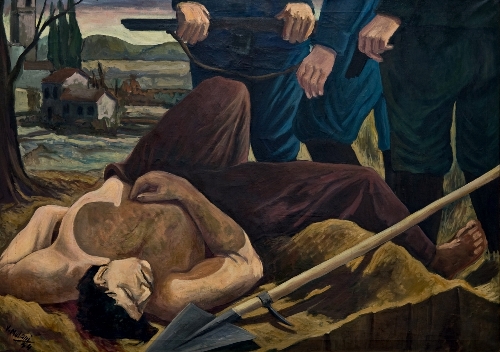
(ITALY ‘44) In 1956, Vasco Melani produced the painting Italy 44 that tells of the drama of war. A single face of a poor man executed next to the hole that he himself was digging. Standing next to him are unidentified figures, only men with big, rough hands who hold arms not to defend themselves, but to kill. No matter who they are, what their faces are, or what they are thinking, Melani emphasizes the cruelty that unites all men at certain moments in life. Italy in 1944 was experiencing a difficult political situation in which ordinary people did not know who an ally was, or who the good and bad guys were. An eclectic artist, Vasco Melani was able to look around and document what he saw because he had to leave his mark using every art form with which he could express himself. Not only did he have to communicate, but also to report the evidence very carefully and accurately.
mm 970x1370