
Camilla Pelleri was born in Florence in 1991. Greatly interested in nature and animals, her parents very soon gave her a camera. She has never forsaken it since, so as not retain an image that she wants to store more than as merely a memory. Photography took her on a daily search as she wanders through urban mazes and ravines that are seldom identifiable to discover the pleasure of sharing them through the eye of a lens. Photographing buildings, people, landscapes, lights, anything that caught her attention and aroused her curiosity, she very soon realized that she liked what she was doing. She grew up and her travels became ever farther, more distant and more adventurous, allowing her to play with light and colors that are often very difficult to immortalize. some of her solitary moments of study and reflection on the world that surrounds her and excites her have included the desert; North Africa’s crowded, chaotic cities and ports; magical Petra; the Atlantic Ocean; and the northern seas in addition to autumn in the Dolomites or soft light of the Arezzo countryside. Unpretentious and solitary, she keeps to herself in her search for intriguing moments of common life.
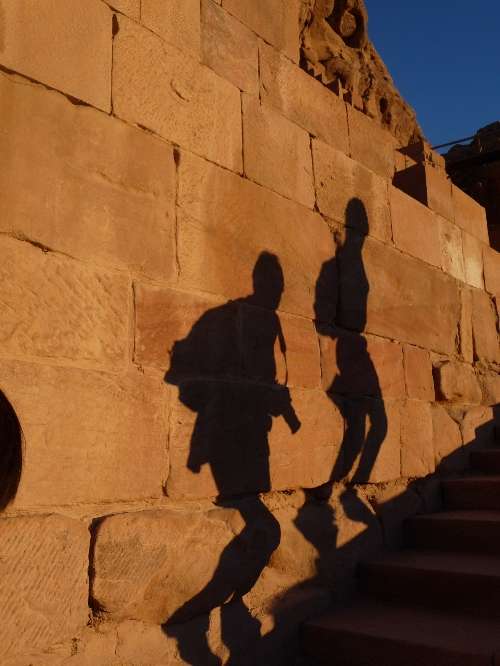
Traveling is an interesting study on the effects that some shadows can have on photographic images when caught unexpectedly. Shadows become the main element in Camilla Pelleri's photographic experiments. The artist plays with the effect shown on the wall, becoming a fundamental support and serving to intensify the search for light. Indeed, a particular journey emerges from the silhouettes of the hikers’ shadows on an ancient Egyptian wall, which last for a very short time, merely that instant when the earth revolves quickly around the sun. It is not the psychology of the model that has caught Pelleri's attention, as portraits do not seem to interest her. Rather, it is the language of bodies moving soundlessly, accompanied by very intense light and chromatic effects against unusual backgrounds. Inspired by lightning flashes or a gradual dimming, the figures often become decorative elements in daunting scenes where the artist moves about in search of the maximum aperture of the visual field without drawing away from the attention and tension of the details.
mm 600x400