
Cesar Santos (b. 1982), Cuban-American Santos art education is worldly, and his work has been seen around the globe, from the Museum of Contemporary Art in Sicily, Italy and the Beijing museum in China to Chelsea, New York. Santos studied at Miami Dade College, where he earned his Associate in Arts degree in 2003. He then attended the New World School of the Arts and, just before graduating with a Bachelor of Fine Arts, he dropped out to study abroad and to amplify his understanding of art. In 2006, he completed the Angel Academy of Art in Florence. Santos’ work reflects both classical and modern interpretations juxtaposed within one painting. His influences range from the Renaissance to the Masters of the Nineteenth Century to Contemporary Art. With superb technique, he infuses a harmony between the natural and the conceptual to create works that are provocative and dramatic. Among Santos’ solo shows are "Drawings" at Waltman Ortega Fine Art in Miami, “Syncretism” at Eleanor Ettinger Chelsea Gallery in New York and “Beyond Realism” with Oxenberg Fine Arts in Miami, among many others. The artist has received numerous accolades, including first place in a Metropolitan Museum of Art Competition, and he was recently presented with the 2013 Miami Dade College Hall of Fame Award in Visual Arts. His work has been exhibited throughout the United States, Europe, Latin America and Asia, including the Villa Bardini Museum in Florence and the National Gallery in Costa Rica.
Santos was struck by Masaccio’s absolute modernity, by a search for a naturalism and verism that entered the rules of art only many centuries later, and by that spontaneous and unusual interest in daily life that also memorably introduced those slices of life into religious contexts. Unquestionably having reaped Masaccio’s legacy, Pietro Annigoni was the modern artist who pushed Santos to use copying, primarily through drawings, as a means to train and stimulate his artistic abilities. Consequently, as was the case in antiquity, the Idea, i.e., the moment of a work is created, became the culminating phase in the evolutionary process of his work. Annigoni’s workshop was a place for personal reflection and comparison with colleagues and the public, as well as for experimentation and a commingling of techniques, styles, and languages. It was where Santos found the right balance to advance along his path. The two portraits in the exhibition blend oil painting, used for the hyper-realistic faces, with the use of wax crayons to complete the dramatic context with elements from the worlds of comics and childhood, managing to offer a work of great harmony and contemporaneity.
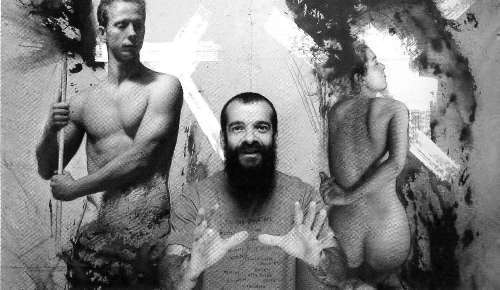
This portrait of the painter James belongs to Cesar Santos's Syncretism where the artist combines complex and differing forms on the same canvas. Santos had an exhibition in New York in 2011 at which he exhibited numerous canvases based on syncretism. Santos’s randomly introduced such great masters as Michelangelo, Arcimboldo, Vermeer, Munch, Picasso, and Klee into his paintings, becoming complements to his original and unrestricted art. A friend is shown embracing the girl with a pearl earring. Two nude figures touch fingers like in Michelangelo's Sistine Chapel a young girl paints Giuseppe Arcimboldo’s Summer on an easel. Munch’s The Scream is seen in all its dramatic profundity behind a young model. He manages to compose a perfect equilibrium with pure irony as well as great mastery. We also find this same procedure in the painting James that the artist donated to Mac,n. The precision and attention to physical and spiritual detail is seen in James's face and his tattooed chest that blends with the purity of the simple and spontaneous lines of the canvas on the easel. This reference to children's art, recognized frequently by such artists as Klee, Miró, and Kandinsky, transcends any sort of cultural convention, recovering one’s own creative spirit.

mm 910x710
Developing an Art Series, a video by Cesar Santos, belongs to the artist’s clear-cut project to describe how he works using video. While showing the materials and subjects he wants to present, Santos recounts his life and introduces images of works by great old and modern masters that have particularly impressed and intrigued him. He shows his reality-based drawings that are filled with cultural notes and feelings of emotion. A lively, rapid, and dynamic narrative imparts the artist’s profound and serious quest to adroitly fit together styles and forms that establish a dialogue between past and present.
mm x