
Leonardo Savioli was born in Florence in 1917.
In 1981 he wrote his autobiography, an exhaustive account which threw a great deal of light not only on his life but also on his personality and great sensitivity, his capacity to find joy and interest in little everyday things. “Still today, after such a long time, I have the ingenious actions of the hands of my mother and father before my eyes. I enjoyed going to school above all because of my schoolmates and I also enjoyed the long journey on foot between home and school. I loved this road immensely because I always met people on my solitary journey”. (Registrare l'esistenza..., 2010, p.12). An intelligent, thoughtful and highly sensitive child, Savioli credited this to his long periods of illness. “Then my illnesses came and had to stay in bed for about two years. But, although I can say this only now, these illnesses were necessary to me. I emerged from this long twilight with new, attentive and curious eyes, those of a child in a man’s body, a child now suddenly adult” (ibidem, p. 16). His curiosity about everything around him took him to Humanities studies and, after graduating from Florence’s Galileo classics high school, he enrolled on architecture at Florence University and graduated in 1941. At university he met and became friendly with Leonardo Ricci and attended Giovanni Michelucci’s lessons with him. During his last year at university he worked as teaching assistant and researcher at the town planning department. From 1943-5 he created a design cycle called La citta ideale in which Florence was subjected to utopian transformations designed to make it increasingly functional for its residents. From 1944 he began working professionally with Leonardo Ricci and Giuseppe Gori and with them designed Pescia’s fruit and vegetable market with a design which won the top prize at Sao Paulo Biennial in Brazil in 1953. At the end of the war Florence was bridgeless, these having all been destroyed by the Germans on their retreat, and Savioli decided to take part in the rebuilding competitions planning conservation restoration work. His long and fertile partnership with Danilo Santi began in 1948. In 1950 he married Flora Wiechmann and designed their home in front of the Galluzzo Certosa, building a studio nearby only in the 1968-70 period. From 1960 to 1970 he designed and built Villa Sandroni, Villa Taddei, Villa Bayon and Verrazzano bridge in Florence and the Montecatini cemetery. He taught interior design and décor from 1964 and died in Florence on 11th May 1982.
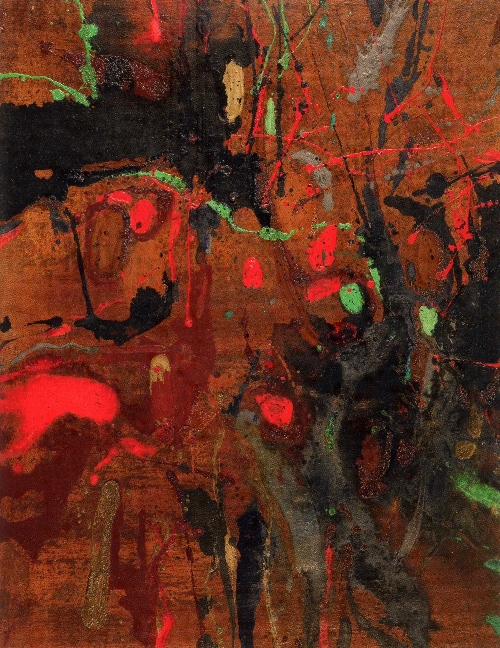
In a volume on Savioli’s work written in 2010 (see Registrare l'esistenza. La pittura e li disegno di Leonardo Savioli, exhibition catalogue curated by C. Paolini and E. Tolu, mac,n Villa Renatico Martini, Monsummano terme (PT), 28th March -27th June 2010, Edizioni Polistampa, Florence, 2010, p.5) Eleonora Tolu wrote: “... the early 1950s saw him experimenting with a freer painting style made up of ultra-mobile brush strokes in which pure, abstract colour were fundamental. The human body is examined in this work almost as if it were a territory and it is here that Savioli’s architectural profession is evident: the structure of the human body is important with its various parts, like elements in a city... As the decade wore on and into the 1970s Savioli’s graphics and paintings were increasingly inspired by the Informal style. He interpreted this artistic current, contemporary to him, in an ultra-personal way influenced by his architectural profession. It was the season of colour, matter and gestural abstraction but it was never entirely gestural for him. There are always references to a design, defined colour backgrounds, axes and planes intersecting”. (p.57). These words fit the 1956-7 untitled painting donated by Savioli’s wife, Flora Wiechmann Savioli perfectly. It is a work in which colour, large brush strokes free of rules and conditioning from which natural forms emerge in which any rational organisation whatsoever is absent. The fundamental components of his Informal painting become action and matter and the artist embodies he who does not create new events but lets them happen, limiting himself to encouraging this with spontaneity and improvisation. The painting’s violent colour and thick material marks which overlap and intersect in a disordered way on the canvas are determinant in an understanding of the dramatic quality of Savioli’s work in which observers are struck by the power and determination of his penetrating expressive dialectic.
mm 1095x900