
Paolo Tesi was born in Pistoia in 1945.
He trained at its art school in the 1970s when the atmosphere in its classrooms was still that of a historic workshop. He subsequently studied at Magistero d'Arte di Porta Romana in the graphic-technical engraving arts sections attending the studios of Lucio Venna and Pietro Parigi. At the Florence Accademia di Belle Arti he enrolled on painting lessons by Ugo Capocchini and Fernando Farulli. In the history of art field at Florence University he attended courses by Alessandro Parronchi and Luigi Baldacci. He taught life drawing and history of art and is part of the Pistoia art and culture journal Il Foglio’s editorial team. He has worked on a number of mural tempera paintings on private commission mainly for interior decoration and one external work together with Siliano Simoncini and architect Roberto Brunetti, the painting decorations for a vast play area created by Pistoia’s local council (see A.U., urban décor journal, year V, Januray-March 1985). Work by him has been used for industrial product advertising and brand identification and as a symbol as was the case for the Lega Regionale Equitazione Toscana. In 1973 he held a solo exhibition in Pistoia at the Il Quadrato gallery while the subsequent year he exhibited a retrospective of portraits and human figures at the Leonardo da Vinci cultural centre, once again in his home town. In 1979 he inaugurated a solo exhibition at the Novelli gallery in Verona, critically introduced by Licisco Magagnato, and presented his characteristic horses in the context of the international horse fair held annually in Verona. In 1980 in Florence he exhibited at the Inquadrature gallery and the next year in Rome at Citibank and in 1982 he held two play themed exhibitions, one in Oristano at its contemporary art gallery and the other, Toys, at Rome’s Margherita gallery. In 1980 he took part in both the international graphic art gallery in Pistoia and the Grafica atto primario event at Montecatini Terme (PT). In 1989 he curated the volume and exhibition 500 libretti di mal'Aria, published by Arrigo Bugiani. In 1990 he founded the art and literature journal Ombrone for which he made an engraving collection, Ombrocello, designed to promote graphic art.
In 1992 he curated the Febbre libraria fra progetto e diletto catalogue and organised a graphic art and art book exhibition in Arezzo (1992), Pistoia (1992) and Lugano (1994).
In 2006 he exhibited the whole collection of the Ombrone journal he set up at Palazzo Pitti’s modern art gallery in Florence. In 2011 his paper work played a centre stage role in an exhibition at the Palazzo Lanfranchi graphics museum in Pisa entitled Un Anno con Pinocchio.
In September-November 2012 at Palazzo Pretorio in Buggiano (PT) he inaugurated his Colore del Segno exhibition.
UNTITLED
Horses play a centre stage role in Paolo Tesi’s figurative work which encompasses oils, watercolours, graphic work and also large tempera wall murals made to private commissions. It is a theme which he has interpreted in various ways in realistic form or purely symbolically deriving from equestrian statues, playing cards and popular figures frequently found in everyday life. All this is part of Tesi’s personal history. Right from the start he has seen the readiness and physical strength of horses with their centuries of iconography and symbolism as a perfect emblem in every occasion. There is nothing surprising, then, about finding a collection devoted to two horses’ heads with a gentle breeze ruffling their manes and animating brush strokes and figures. His lines seem charged with an irresistible vitality and show horses’ impulsive but generous temperament, always ready to help and protect human beings. Proud animals, always at the disposal of their masters, horses are frequently accompanied by indefatigable warriors but also workers taking on their daily lives with a spirit of sacrifice and always with dignity and respect. These were Umberto Castelli’s words in his presentation: “...the occasion of this anniversary of the Associazione degli Industriali Pistoiesi was an opportunity for local artistic expression with work by eleven, mostly young, Pistoia province artists, all well-known teachers at academies and art schools. They took on the theme of WORK in a global sense...”.
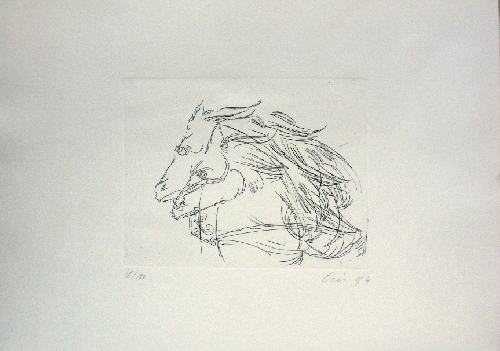
mm 245x298