
A resident in Italy since 2001, Justin Randolph Thompson has exhibited internationally. In addition, he has participated in numerous artist-in-residence programs in the United States and Europe. His works explore the historical implications of triumph, victory, and ascension through a re-contextualization of antique Roman references related to aspects of African-American culture from both the past and the present. Exploring the cultural shift and imposed hierarchies, Thompson adorns status symbols with hybrid connotations through a talismanic application of culturally specific materials. His work includes sculpture, installations, performance, video, and sound. Reflecting on the legacy of socially constructed communities, Thompson examines expectations and shortcomings through the absence of a concrete, linear foundation. Thompson recently won a visual arts grant from the Fundación Marcelino Botin. He was selected for a 2013 Emerging Artist Fellowship at the Socrates Sculpture Park. Recently, he exhibited a solo project at the Bluestar Contemporary Art Museum in San Antonio (Texas), and also at Cuchifritos Project Space in New York in April.
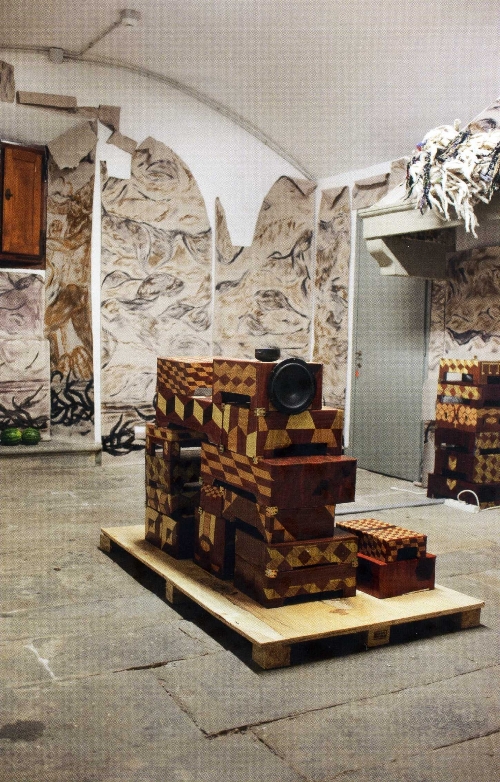
Watermelon Theatre, 2013 (…)Watermelon Theater is an installation as well as a performance based on the flow of cultural enlightenment and its unidirectionality. The elements in this work range from the comedy "Misantropia nella società" (“The Misanthrope in Society”) by Vincenzo Martini, father of Ferdinando Martini, to the Villa Renatico Martini’s service kitchen in addition to Ferdinando’s well-known role in the “Schiavitù d'amore dell'Eritrea Italiana” ("Slavery of Love in Italian Eritrea"). "Misanthropy in society" is a love story on humanity’s philosophical lack of trust and on the abuse of the mind’s power over that of the heart. The comedy exposes some of this philosophy’s false beliefs that were masked from the society of the future, threatening to deal a fatal blow to the idea of a “gentleman”. The work’s title refers to the well-known Renaissance theater located on Via Ricasoli in Florence where many of Vincenzo Martini's comedies premiered. Known as the Teatro del Cocomero (or the Watermelon Theater), it was given this name because, during the Renaissance, fields of watermelons – used in demeaning stereotypes of African-Americans – alternated with the palaces there. Consequently, the work’s title seeks to depict these images within a framework of complex theatricality.
mm x