
After an initial debut in the world of graffiti and street art, where he can concentrate his attention on the plastic value of drawing in its various expressive possibilities, he shows remarkable interest in the study of the sign attending Art Grapichcs at the Academy of Fine Arts in Naples where he graduates with honours. He specializes in Drawing and Engraving Techniques, carrying out from researches according to an aesthetic perspective which defines an expressive eclecticism connected to the sense of form. He collaborates as an assistant in the Art Graphics and Engraving courses at the Academy of Fine Art in Naples. He takes part in collective exhibits and art competitions and wins the 9° Engraving Biennial International Prize “Città di Monsummano Terme” (PT) Italy as well as the XXX° edition of the Fibrenus “Carnello cArte ad Arte” prize.
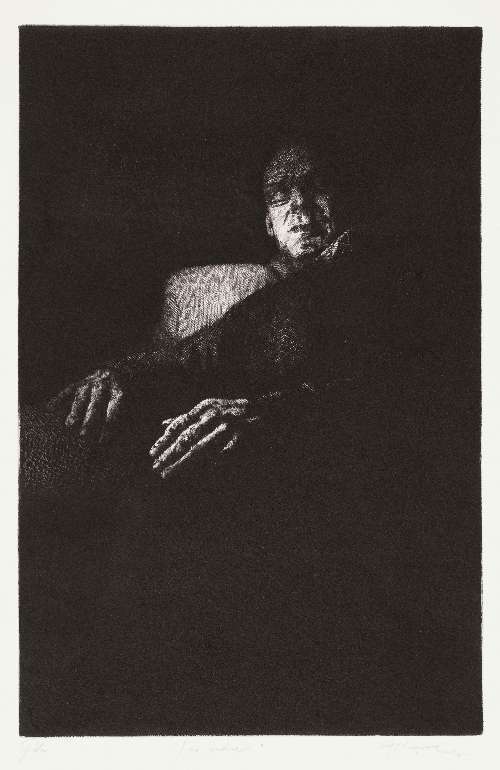
The winner of the 9th City of Monsummano Terme International Biennial Printmaking Prize, Giovanni Timpani made a drypoint engraving portraying his father. The etching blends the deep marks carved into the plate with the pictorial effects from the frequent burrs in drypoint. The artist used his masterly skill and, above all, his great sensitivity and profound spirit to transfer to paper the difficult, yet profound relationship between father and son, moving the jury and the public to a sympathetic understanding. Illuminated by beams of light are the extremely large hands that, marked by time, educate, protect, guide, support, and never lose their important role in the life of a child.
mm 527x346
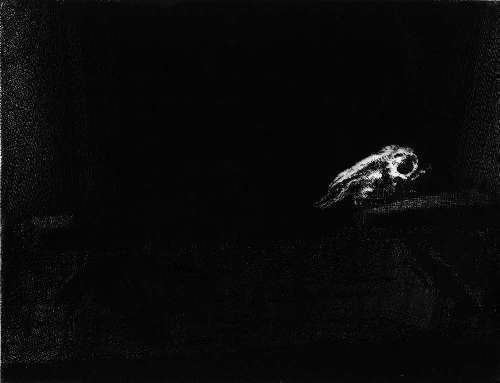
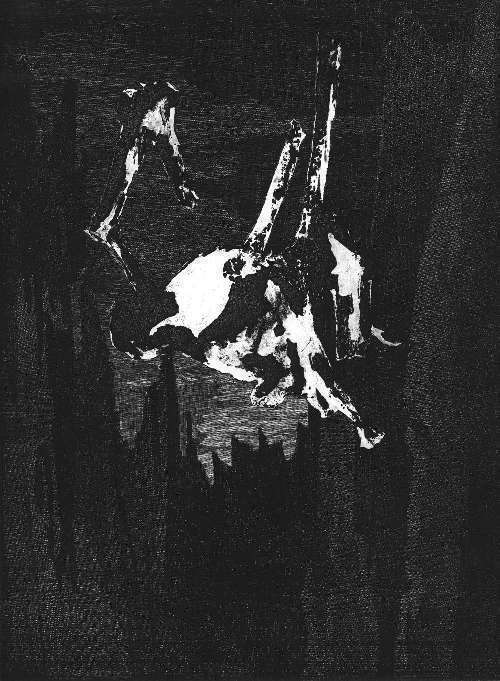
The ghostlike bucranium in this decorative and symbolic image of a fleshless ox skull, widespread in Greek and Roman art, appears on a sheet darkened by a thick web of lines previously engraved on the plate by Timpani. The light is as a cold neon that illuminates only the bucranium. Recognized as the primal element of female sexuality in contemporary art, the artist uses it here to deceive life, to find an eternal aspect of the fragile human experience and essence. Timpani’s great virtuosity is displayed here in its essential lines mix and blend into the black of the background. They convey tension, strength, and illusionism through an evolutionary metamorphosis that has destroyed an earthbound body, devoting instead a skeleton and dust to eternity.
mm 220x280
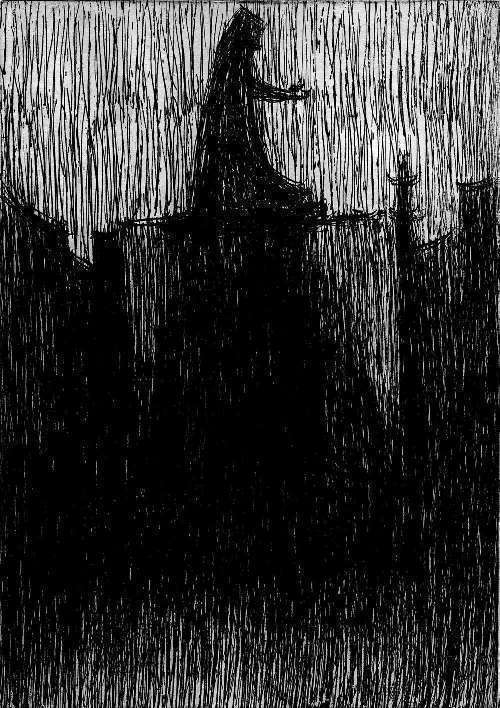
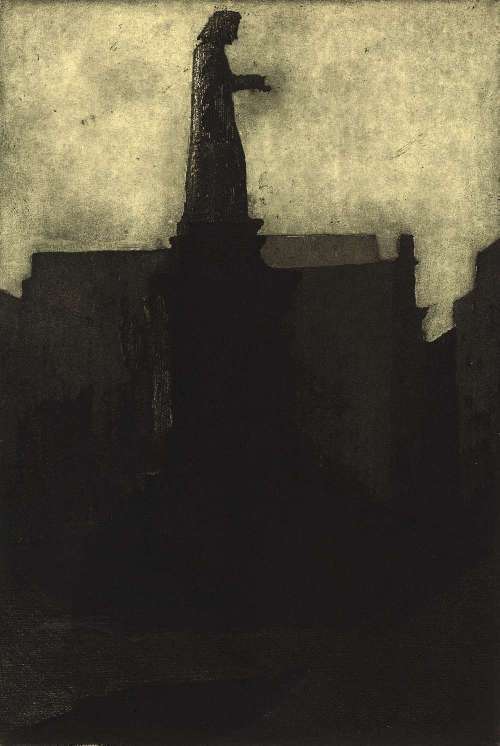
In this etching, Giovanni Timpani manifests all his expressive power using a thick, dark line to suggest the image of the square above which the great poet stands. With its outstretched arm, this dark silhouette dominates the surrounding buildings and houses, emphasizing and spreading his prophetic writings. Anyone who wishes to become acquainted with “To Dante” must overcome the obscure obstacle that precedes the image and go beyond not just the physical barrier, but also those imposed by a complex, codified language, overflowing with didactic and moral allegories, neologisms, and imaginary renderings of reality.
mm 500x350
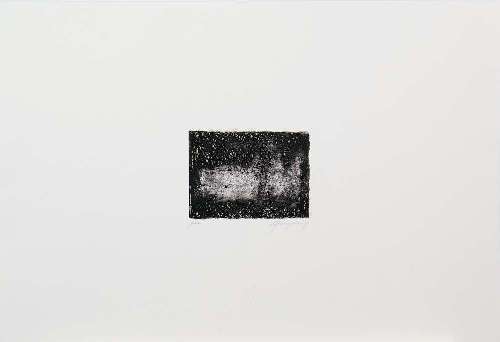
In this small engraving, Timpani presents a mental state in abstract form. The artist illustrates an escape from a narrow, confined space towards a blinding light that leads, not to a defined, recognizable place, but towards a condition of happiness as well as of physical and mental fulfilment. One must go outside to reach infinity, along a luminous trail that passes nearby yet is difficult to reach.
mm 90x120
At the moment of his fall, Icarus felt he was living outside of time and place. His dreams were seemingly broken forever, not just when his certainties were overshadowed by the darkness, but also when that emptiness loomed below him. Only he can control his rapid fall. The artist has an incredible ability to create a sense of speed by his use of chiaroscuro, a decisive element in Giovanni Timpani's engravings.
mm 400x300
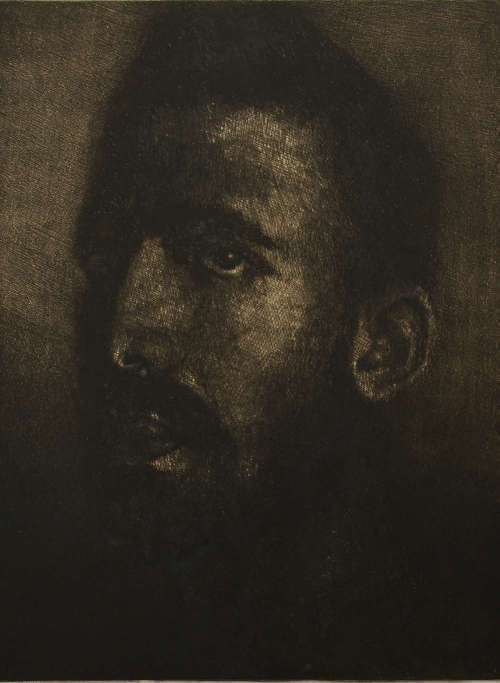
The artist has not portrayed himself in profile, but rather with his face turned slightly to the left. His eyes are illuminated by a ray of light that remorselessly reveals the artist’s extremely subtle introspective and interpersonal study that he is doing with his observers. An eye, a part of his nose, the shape of his mouth, and an ear appear among a mass of hair that blends into the dark background to highlight Timpani’s curiosity and determination to seek a dialogue, to be open to and communicate with his virtual audience, offering aspects of himself accessible only through this atavistic snapshot created through his engraved work.
mm 350x260
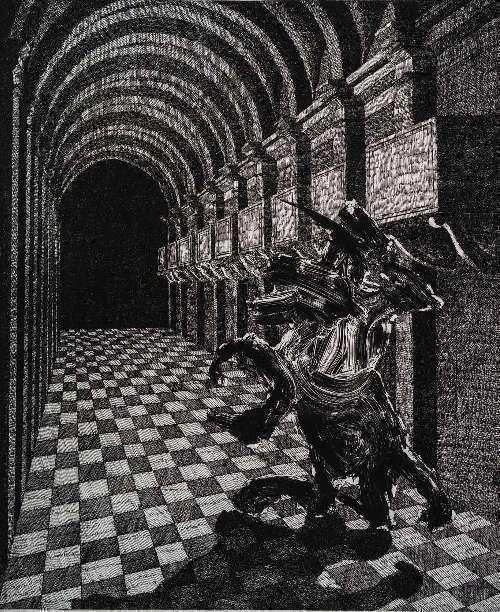
In his figurative historical engraving Interior with Knight, Giovanni Timpani has placed his anonymous, metamorphic knight in a very specific setting: a noble palace that is both unyielding and severe. Here, this twisting, turning chimerical figure seems to belong to the fantastic creations of J.K. Rowling who, in her celebration of Harry Potter, constructed the imaginary Wizarding World. Like the English writer, Timpani does not merely describe what pertains to his own imagination. He looks through his own cultural baggage for forms, juxtaposing the knight’s explosive energy with the silent strength of the arches, supported by columns that run along a checkerboard floor. Timpani clearly had English castles in mind, while also imagining the transparency and dazzling light handed down to us by 16th- and 17th-century Venetian artists. Giovanni Timpani's poetics are drawn into the visionary meanders of the Venetian lagoon led there by Tintoretto, passing through – always in respectful silence – the arcades of a city noted for its light and shadows, unexpected splendors, and shapes built on the chromatic and chiaroscuro effects. An autobiographical figure, his restless, unobserved knight moves in an untouched time and metaphysical space, immersed in a reassuring and benevolent darkness.
mm 600x500
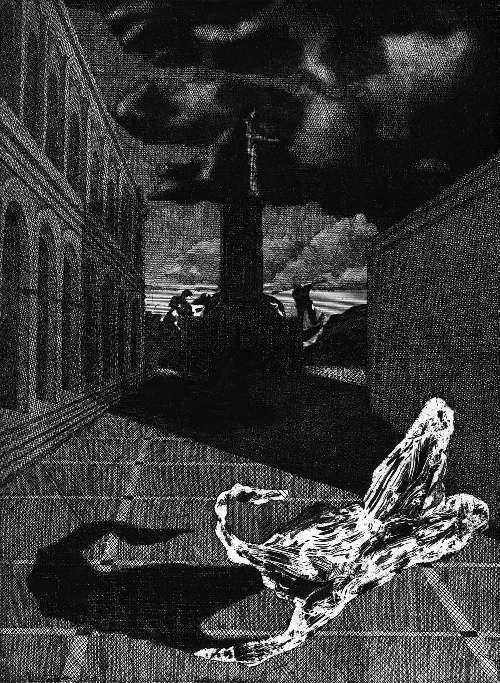
Timpani has placed one of his shapeless mythical figures in a metaphysical landscape, with the typical floors, columns and arcades of 18th-century architecture. The figure slowly drifts to reach a sculpture on a high base that calls to mind Dante with his arm extended, seen before in several of Timpani’s works. The city streets and squares are surrounded by shimmering black clouds and the wonderful light of the sun setting on the sea. Our knight is looking for his dream. He wants to reach the light that will let him enter a fantastic Vision - of the Impermanent, a condition that, recognizing and accepting whatever modifies, transforms, changes form and state, continues to experience internal and external metamorphoses that overcome appearances.
mm 400x300
The first version of this side-view of the statue of Dante, in front of Florence’s Basilica of Santa Croce, was created in 2015. Its masterly chiaroscuro contrasts were created through a painterly aquatint technique. The artist returned to the same subject the following year using a different technique and in particular with a forcefully deep, pronounced line, Dante’s figure is tamer, less threatening. He seems to be carrying on his fragile shoulders the burden of an onerous exile that drained him completely. Timpani has made various engraved versions of this statue of Dante. Accordingly, Dami’s skill at conveying the countless aspects of Dante’s figure as well as his incredibly fluent capacity to convey imaginary depictions of a didactic and moral reality increased each time.
mm 260x180
The usual shapeless, menacing-looking character wanders in a dark space. Perhaps it is a knight seeking to be reunited with his own soul and to achieve balance and harmony by finding to depart from the impending darkness. Surely this search for abstract forms that move about slowly and clumsily in a dark space, with timid infiltrations of light, are a constant in Giovanni Timpani’s art.
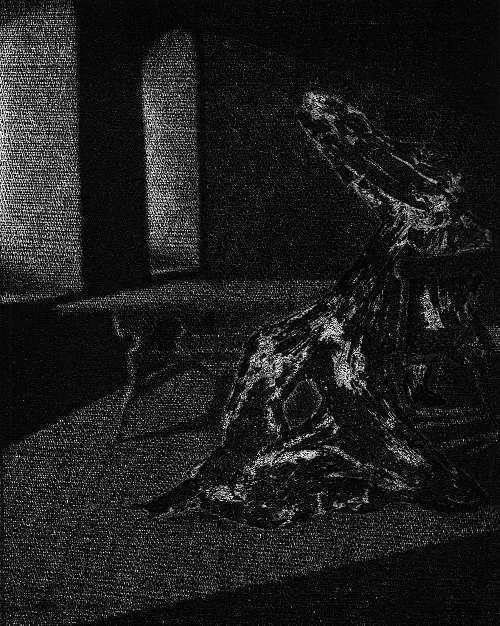
mm 210x170