
Antonino Triolo was born in Reggio Calabria in 1984. In 2007 he graduated in decoration from Reggio Calabria’s Accademia di Belle Arti. In 2009, from the same institution, he obtained a second level degree in Visual Arts and Performance Disciplines specialising in sculpture with a thesis on Libro d'Artista under Sandro Bracchitta. In 2010/11 he enrolled on an engraving course at the Bisonte graphic art school in Florence. He worked as a teaching assistant at the Palermo Accademia di Belle Arti’s engraving programme. This young artist’s interest has shifted towards sculpture in recent years and to his great joy he has discovered an engraving and modelling wood talent. He has begun reflecting on the potential for drawing inspiration for his work from nature, obtaining great equilibrium between virtuosity and respect for natural forms. In addition to wood he has turned his attention to limestone and pumice stone attempting with the former to recreate Primitivism and Intimism forms and, with the latter, as an easy to work material, he has moved in the direction of decomposition and recomposition of the female body generating beauty and sensuality. In engraving wood, as previously on plates, Triolo seeks the elegance and sobriety of Classical forms which do not imitate nature but come from the real and transform into manifestations of sentiment via emotions.
The 5th International Monsummano Terme Engraving Biennial Prize was awarded to Antonino Triolo representing the historic Accademia di Reggio Calabria. As in every edition of the prize the selection committee decided to reward the work which succeeded in melding technique and style by means of the choice of an attractive and aesthetically pleasing subject. The young Triolo obtained this marriage of equilibria via the use of aquatint colour fields and a series of sinuous lines which overlay the etching. The artist’s desire for a three dimensional quality is already visible in this work and in this case is channelled via the use of planes which are differentiated by means of colour and chromatic variations. Twisted forms and colours moving across paper as if they were free of supports have a primordial style acquiring poor forms which frequently originate in nature and the congenital structure of the elements which are modified via the artist’s state of mind.
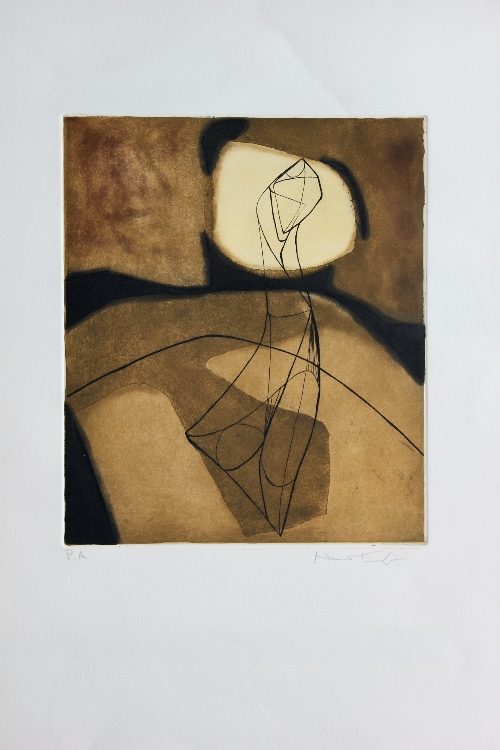
mm 300x250