
The fifth of eight siblings, Cesare Vagarini was born in Rome to Oreste, a royal functionary, and Anna Beni, a housewife, on 14 December 1905. In 1911, the family moved from Rome to Florence. Six years later, after finishing a vocational school, the young man enrolled in the Evening School of Drawing in Via de' Bardi. Vagarini then enrolled at the Art Institute of Santa Croce in 1921, transferring the following year to Porta Romana where he met Aldo Carpi. After graduating from Florence’s Porta Romana Art Institute in 1925, he began working at the Benini Company. From 1925 to 1928, he worked on restorations in Rome, Montecatini, and Monsummano. In Monsummano, he met and then married Maria Cappelli in the Church of Fontenova in 1930. In 1929, Vagarini was given his first assignment to personally restore the tondo in the Chapel of Fra Giuseppe da Pescia in the Church of San Francesco – despite not receiving from the Royal Superintendence of Medieval and Modern Art in Tuscany his official certificate as a restorer until the following year. In 1933, he sent some works to Marinetti, who praised them and encouraged Vagarini to continue. Soon afterward, he was appointed professor of fresco by the director of the Brera Academy of Milan, Aldo Carpi. In 1934, he won first prize in the Milius competition in Milan. There, he met and made friends with Edoardo Persico, editor-in-chief of the magazine Domus. In 1936, he left Milan to work on a fresco in the Basilica of San Lucchese in Poggibonsi and also at the Macchi family’s residence. While visiting the Church of Sant'Agostino in San Gimignano, he discovered frescoes attributed to Bartolo di Fredi in a chapel dedicated to the Virgin Mary. Upon that occasion, he met Enzo Carli, Superintendent of Fine Arts for the provinces of Siena and Grosseto, with whom he began a long working partnership and friendship. Between 1937 and 1938, Vagarini and his wife moved to Montalcino (SI), where he restored the frescoes in the Church of San Francesco and became president of the local branch of Catholic Action. In 1939, he met Antonio Barluzzi, architect in the Holy Land and designer of the Churches of the Visitation in Ein Karem and of San Lazzaro in Bethphage. The following year Vagarini left for Palestine with preparatory sketches to fresco the Church of the Visitation. With the Italian declaration of war on France and Great Britain on 11 June 1940, Vagarini and his wife were arrested the following day in Jerusalem and deported to Tatura, Australia, where they remained until the end of the war. While there, he became friends with Dr. Canova, a name often found in his wife's diaries for the help he provided, and Friar Minor Salvatore Ciliano, with whom he founded the St. Francis Catholic social club and the newspaper La Fiamma. At the end of the war, Vagarini took part in the group exhibition at the Museum of Contemporary Art in Sydney, which acquired his works. The artist began painting again, creating eight large oil paintings for the Mary Immaculate Church in the Waverley suburb in Sidney, and which he completed in 1947. In 1946, he began a successful partnership with the Von Bertouch Gallery in Sidney. In addition, he again took up working on his sketches for the Visitation in Ein Karem, which had been interrupted by his deportation. In 1948, Vagarini left Australia and returned to Palestine, where he was surprised by the first Arab-Syrian war. Returning to Italy, he landed in Genoa shortly after the famous elections of 18 April 1948. In 1949, he began his painting cycle of the Nazi-Fascist raids and reprisals in Versilia. He met the painter Raffaele De Grada. Vagarini returned to Palestine to complete the Visitation’s frescoes In 1950, he had an exhibition at the Galleria Bergamini in Milan. The exhibition’s introduction was given to Aldo Carpi, director of the Brera Academy. In 1953, he took part in the National Painting Exhibition in Vado Ligure, and then participated in the Biennial of Padua in 1954. Vagarini continued to publish articles on his art in Italian and foreign magazines, like Mattino of Padua and Revue d'Art Moderne des Arts e de la Vie. In 1959, he won the Poggibonsi Art Award and exhibited at the Santa Trinita Gallery in Florence. Between 1951 and 1973, he was commissioned by the Superintendency of the Galleries of Siena and Grosseto to carry out several restorations. In 1961, the artist participated in Arezzo Art, and the following in the IV Biennial of Sacred Art at the Commissariat of the Holy Land in Lucca. In 1966, he exhibited at the National Exhibition of Florence. He received the papal honor of becoming a knight of the Order of Saint Gregory the Great in 1973. In the decade between 1983 and 1993, there were numerous personal exhibitions in San Gimignano where Vagarini lived and worked until his death in 1990.
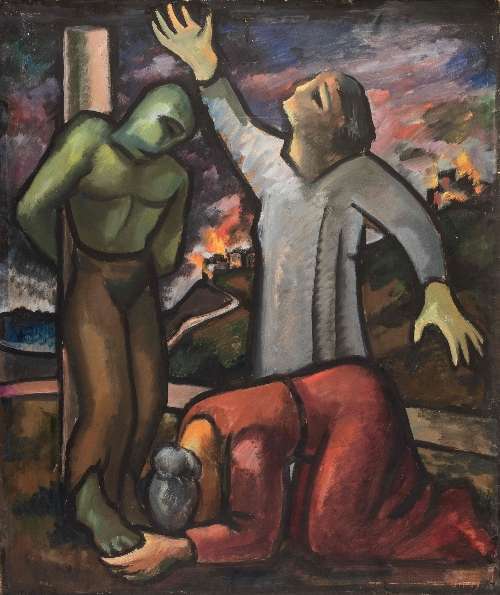
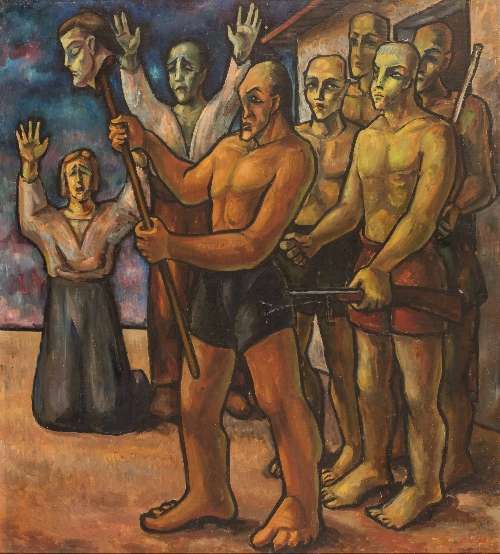
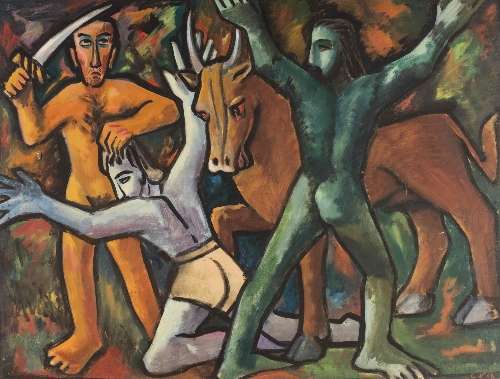
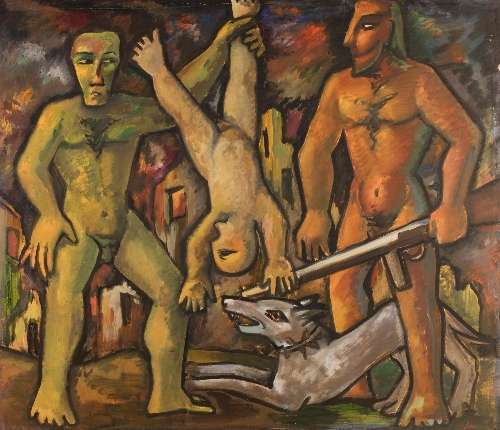
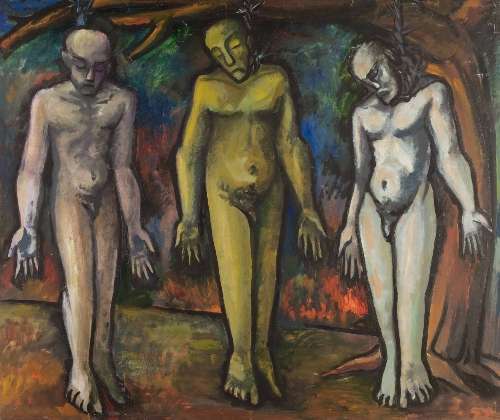
Victims, Martyrs of Sant’Anna, Barbarian Trophy, Decapitation, No Mercy, Three Martyrs Six paintings by Cesare Vagarini (Rome 1905-San Gimignano 1954) are part of the Mac,n collection, Before Italy entered the war on the side of Germany, Vagarini had gone with his wife to Jerusalem to carry out some works of pictorial decoration. Because of Italy’s political position at that time, he was deported to a concentration camp in Tatura, Australia, where he remained, living under difficult conditions, until the end of the war. When Vagarini returned home, he learned of the chilling barbarities carried out by the Nazis and Fascists in his homeland, especially a very detailed retelling of the massacre at Sant’Anna di Stazzema. As a result, he decided to working on this subject, creating a series of drawings and paintings that brutally document those terrible moments experienced by a population of mainly the elderly, women, and children. As the titles of the works make clear, Vagarini focused on dramatic descriptions of the war’s most painful events, when a weak, defenseless people were stripped, beheaded, shot in front of their families or their throats slit in order to intensify the pain and agony surrounding this already incomprehensible drama. A sense of despair in the tormented images comes out from the strong color contrasts, the anatomically disproportionate forms, and especially by the torturers’ diabolical faces that spread an uncontrollable sense of desperation throughout the scene. The Martyrs of Sant’Anna makes reference to the Crucifixion of Christ by Scipio Pulzone (Gaeta 154 ca. - Rome 1598), with Mary Magdalene kneeling at Christ’s feet as St. John looks skyward, beseeching help from God the Almighty.

mm 1000x800
Victims, Martyrs of Sant’Anna, Barbarian Trophy, Decapitation, No Mercy, Three Martyrs Six paintings by Cesare Vagarini (Rome 1905-San Gimignano 1954) are part of the Mac,n collection, Before Italy entered the war on the side of Germany, Vagarini had gone with his wife to Jerusalem to carry out some works of pictorial decoration. Because of Italy’s political position at that time, he was deported to a concentration camp in Tatura, Australia, where he remained, living under difficult conditions, until the end of the war. When Vagarini returned home, he learned of the chilling barbarities carried out by the Nazis and Fascists in his homeland, especially a very detailed retelling of the massacre at Sant’Anna di Stazzema. As a result, he decided to working on this subject, creating a series of drawings and paintings that brutally document those terrible moments experienced by a population of mainly the elderly, women, and children. As the titles of the works make clear, Vagarini focused on dramatic descriptions of the war’s most painful events, when a weak, defenseless people were stripped, beheaded, shot in front of their families or their throats slit in order to intensify the pain and agony surrounding this already incomprehensible drama. A sense of despair in the tormented images comes out from the strong color contrasts, the anatomically disproportionate forms, and especially by the torturers’ diabolical faces that spread an uncontrollable sense of desperation throughout the scene. The Martyrs of Sant’Anna makes reference to the Crucifixion of Christ by Scipio Pulzone (Gaeta 154 ca. - Rome 1598), with Mary Magdalene kneeling at Christ’s feet as St. John looks skyward, beseeching help from God the Almighty.
mm 840x710
Victims, Martyrs of Sant’Anna, Barbarian Trophy, Decapitation, No Mercy, Three Martyrs Six paintings by Cesare Vagarini (Rome 1905-San Gimignano 1954) are part of the Mac,n collection, Before Italy entered the war on the side of Germany, Vagarini had gone with his wife to Jerusalem to carry out some works of pictorial decoration. Because of Italy’s political position at that time, he was deported to a concentration camp in Tatura, Australia, where he remained, living under difficult conditions, until the end of the war. When Vagarini returned home, he learned of the chilling barbarities carried out by the Nazis and Fascists in his homeland, especially a very detailed retelling of the massacre at Sant’Anna di Stazzema. As a result, he decided to working on this subject, creating a series of drawings and paintings that brutally document those terrible moments experienced by a population of mainly the elderly, women, and children. As the titles of the works make clear, Vagarini focused on dramatic descriptions of the war’s most painful events, when a weak, defenseless people were stripped, beheaded, shot in front of their families or their throats slit in order to intensify the pain and agony surrounding this already incomprehensible drama. A sense of despair in the tormented images comes out from the strong color contrasts, the anatomically disproportionate forms, and especially by the torturers’ diabolical faces that spread an uncontrollable sense of desperation throughout the scene. The Martyrs of Sant’Anna makes reference to the Crucifixion of Christ by Scipio Pulzone (Gaeta 154 ca. - Rome 1598), with Mary Magdalene kneeling at Christ’s feet as St. John looks skyward, beseeching help from God the Almighty.
mm 780x700
Victims, Martyrs of Sant’Anna, Barbarian Trophy, Decapitation, No Mercy, Three Martyrs Six paintings by Cesare Vagarini (Rome 1905-San Gimignano 1954) are part of the Mac,n collection, Before Italy entered the war on the side of Germany, Vagarini had gone with his wife to Jerusalem to carry out some works of pictorial decoration. Because of Italy’s political position at that time, he was deported to a concentration camp in Tatura, Australia, where he remained, living under difficult conditions, until the end of the war. When Vagarini returned home, he learned of the chilling barbarities carried out by the Nazis and Fascists in his homeland, especially a very detailed retelling of the massacre at Sant’Anna di Stazzema. As a result, he decided to working on this subject, creating a series of drawings and paintings that brutally document those terrible moments experienced by a population of mainly the elderly, women, and children. As the titles of the works make clear, Vagarini focused on dramatic descriptions of the war’s most painful events, when a weak, defenseless people were stripped, beheaded, shot in front of their families or their throats slit in order to intensify the pain and agony surrounding this already incomprehensible drama. A sense of despair in the tormented images comes out from the strong color contrasts, the anatomically disproportionate forms, and especially by the torturers’ diabolical faces that spread an uncontrollable sense of desperation throughout the scene. The Martyrs of Sant’Anna makes reference to the Crucifixion of Christ by Scipio Pulzone (Gaeta 154 ca. - Rome 1598), with Mary Magdalene kneeling at Christ’s feet as St. John looks skyward, beseeching help from God the Almighty.
mm 720x950
Victims, Martyrs of Sant’Anna, Barbarian Trophy, Decapitation, No Mercy, Three Martyrs Six paintings by Cesare Vagarini (Rome 1905-San Gimignano 1954) are part of the Mac,n collection, Before Italy entered the war on the side of Germany, Vagarini had gone with his wife to Jerusalem to carry out some works of pictorial decoration. Because of Italy’s political position at that time, he was deported to a concentration camp in Tatura, Australia, where he remained, living under difficult conditions, until the end of the war. When Vagarini returned home, he learned of the chilling barbarities carried out by the Nazis and Fascists in his homeland, especially a very detailed retelling of the massacre at Sant’Anna di Stazzema. As a result, he decided to working on this subject, creating a series of drawings and paintings that brutally document those terrible moments experienced by a population of mainly the elderly, women, and children. As the titles of the works make clear, Vagarini focused on dramatic descriptions of the war’s most painful events, when a weak, defenseless people were stripped, beheaded, shot in front of their families or their throats slit in order to intensify the pain and agony surrounding this already incomprehensible drama. A sense of despair in the tormented images comes out from the strong color contrasts, the anatomically disproportionate forms, and especially by the torturers’ diabolical faces that spread an uncontrollable sense of desperation throughout the scene. The Martyrs of Sant’Anna makes reference to the Crucifixion of Christ by Scipio Pulzone (Gaeta 154 ca. - Rome 1598), with Mary Magdalene kneeling at Christ’s feet as St. John looks skyward, beseeching help from God the Almighty.
mm 900x1050
Victims, Martyrs of Sant’Anna, Barbarian Trophy, Decapitation, No Mercy, Three Martyrs Six paintings by Cesare Vagarini (Rome 1905-San Gimignano 1954) are part of the Mac,n collection, Before Italy entered the war on the side of Germany, Vagarini had gone with his wife to Jerusalem to carry out some works of pictorial decoration. Because of Italy’s political position at that time, he was deported to a concentration camp in Tatura, Australia, where he remained, living under difficult conditions, until the end of the war. When Vagarini returned home, he learned of the chilling barbarities carried out by the Nazis and Fascists in his homeland, especially a very detailed retelling of the massacre at Sant’Anna di Stazzema. As a result, he decided to working on this subject, creating a series of drawings and paintings that brutally document those terrible moments experienced by a population of mainly the elderly, women, and children. As the titles of the works make clear, Vagarini focused on dramatic descriptions of the war’s most painful events, when a weak, defenseless people were stripped, beheaded, shot in front of their families or their throats slit in order to intensify the pain and agony surrounding this already incomprehensible drama. A sense of despair in the tormented images comes out from the strong color contrasts, the anatomically disproportionate forms, and especially by the torturers’ diabolical faces that spread an uncontrollable sense of desperation throughout the scene. The Martyrs of Sant’Anna makes reference to the Crucifixion of Christ by Scipio Pulzone (Gaeta 154 ca. - Rome 1598), with Mary Magdalene kneeling at Christ’s feet as St. John looks skyward, beseeching help from God the Almighty.
mm 900x1050